

ACL Tear
An ACL (anterior cruciate ligament) tear is an injury to one of the main stabilising ligaments of the knee. It is common in sports that involve sudden changes of direction, jumping, landing or pivoting, such as football, netball, basketball and skiing.
Dr Varun Arora assesses and treats patients with ACL tears across Melbourne and regional Victoria, tailoring treatment to each person's knee, activity level and goals.
What is an ACL tear?
The ACL runs through the centre of the knee, from the thigh bone to the shin bone. It stops the shin bone sliding forwards and controls rotation, which keeps the knee stable when you twist, cut or land. When the ACL tears, the knee may give way with these movements, even though it feels normal walking in a straight line.
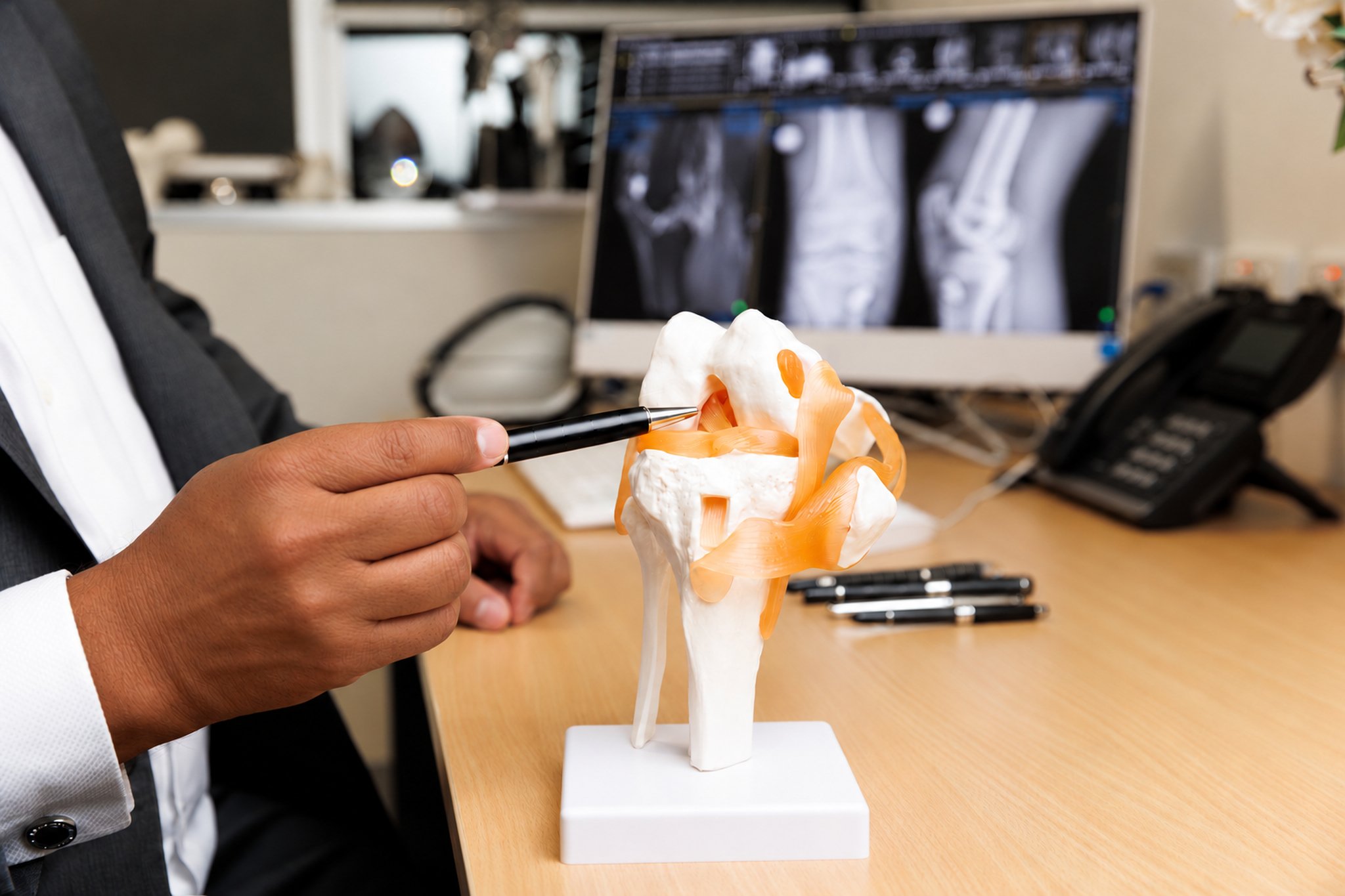
ACL: Anterior cruciate ligament
1. ACL Tear (this page): the injury, diagnosis and your treatment options
ACL Injury Guide
2. ACL Reconstruction → the operation, recovery and return to sport
Symptoms
Common symptoms of an ACL tear include:
A pop or popping sensation at the time of injury
Rapid swelling, usually within a few hours
Difficulty continuing to play or walk normally straight after the injury
Reduced range of motion, especially difficulty fully straightening the knee
Later, a feeling of instability or the knee giving way when you twist, turn or change direction
Pain and swelling often settle over a few weeks, so the knee can feel deceptively normal in a straight line. Instability tends to show up when you return to twisting or pivoting.

Causes and risk factors
Most ACL tears happen without contact from another player. Common mechanisms include:
Sudden changes of direction or pivoting on a planted foot
Landing awkwardly from a jump, particularly with the knee falling inwards
Sudden deceleration
Direct contact or collision
The risk is higher in pivoting and landing sports, in women and girls (who have a higher rate of ACL injury in the same sports), after a previous ACL injury to either knee, and with a family history of ACL tears.
Straight after the injury
If you think you have injured your ACL, these first steps help:
-
Stop playing
Don't try to "run it off". Continuing on an unstable knee can damage the meniscus and cartilage.
-
Follow PRICE for the first 48 to 72 hours
Protect the knee (crutches if you are limping), rest, ice for 15 to 20 minutes every two to three hours, compress with a bandage, and elevate the leg. Avoid heat, alcohol, running and massage for the first few days, as they increase swelling.
-
See your GP or a sports doctor within a few days
They can examine the knee, arrange an x-ray if needed, and organise an MRI and referral.
-
Start physiotherapy early
The early goals are to settle swelling, get the knee fully straight, restore bend and switch the quadriceps back on. This helps whichever treatment you choose.
-
Arrange a surgical review
Ideally review within one to two weeks, so a plan is in place while the knee settles.
Seek urgent review if the knee is locked and cannot straighten, the knee joint or kneecap has dislocated, the foot is numb, cold or pale, or you cannot bear any weight. These can signal a displaced meniscal tear, a fracture or an injury to several ligaments.
How is an ACL tear diagnosed?
Diagnosis starts with the story of the injury and an examination. Specific tests, such as the Lachman test and the pivot shift test, check how much the shin bone moves forward and rotates. These can be difficult in the first few days when the knee is swollen and sore, so a repeat examination is common.
X-rays look for a fracture, including a small chip of bone that can be pulled off with an ACL tear.
MRI confirms the ACL tear and shows associated injuries to the meniscus, cartilage, bone and other ligaments. This helps plan treatment and its timing.
Injuries that often come with an ACL tear
Meniscal tears. Around half of ACL injuries include a tear of the meniscus, the knee's cartilage shock absorber. Some can be repaired, which is one reason early assessment matters. See Meniscal Tear.
MCL injury. The ligament on the inner side of the knee. Most MCL injuries heal without surgery, often with a brace, and an ACL reconstruction may be timed to allow this. See MCL Tear.
Bone bruising. Seen on MRI in most ACL injuries, where the bones impact as the knee gives way. It settles with time but can make the knee ache for several weeks.
Cartilage injury to the joint surface
Other ligament injuries, such as the PCL or the ligaments on the outer side of the knee. Injuries to several ligaments need a different plan. See PCL Tear and LCL Tear.
Treatment options for an ACL tear
Treatment depends on how unstable your knee is, any associated injuries, your activity level, and your goals for sport, work and daily life. A completely torn ACL rarely heals back to normal function, but not everyone with a torn ACL needs an operation.
| Comparison | Rehabilitation first | ACL reconstruction |
|---|---|---|
| Often suits | Straight-line or lower-demand activities, a knee that feels stable once settled, no repairable meniscal tear | Pivoting, cutting or contact sport, a knee that gives way, a repairable meniscal tear, or other ligament injuries |
| What it involves | Several months of structured physiotherapy, with surgery later if the knee stays unstable | Prehab to settle the knee, keyhole surgery with a tendon graft, then nine to twelve months of rehabilitation |
| Return to pivoting sport | Possible for some, but the knee may give way | Usually at nine to twelve months, once testing is passed |
| Main risks | Further meniscal and cartilage damage if the knee keeps giving way | Surgical risks, including infection, stiffness and graft failure |
| More information | Discussed with your physiotherapist and Dr Arora | ACL Reconstruction |
Both paths need committed rehabilitation. Dr Arora will help you weigh up the options for your knee and your goals.
Living with an ACL-deficient knee
If you choose rehabilitation, a structured program over several months builds strength, balance and control. It usually includes:
Physiotherapy focusing on the quadriceps, hamstrings, hip and landing control
Favouring straight-line activities such as cycling, swimming, running and gym work
Avoiding pivoting sport until the knee is stable, and being reviewed if it gives way
A brace in some cases for confidence. A brace does not replace rehabilitation.
When reconstruction is recommended
Reconstruction is usually recommended if you want to return to pivoting sport, your knee keeps giving way despite rehabilitation, or you have a repairable meniscal tear or other ligament injuries. It is keyhole surgery in which a graft, usually a tendon from your own knee, replaces the torn ligament. See ACL Reconstruction for graft choices, the operation, recovery and returning to sport.
Why timing matters if your knee is unstable
Each time a knee without a working ACL gives way, the shin bone shifts and can trap and tear the meniscus or damage the joint surface. The longer a knee stays unstable during active use, the more likely meniscal and cartilage damage becomes, and the more likely a meniscal tear is to be the type that can't be repaired. This is linked to arthritis later in life.
Surgery is not usually done in the first days after injury. It is planned once swelling has settled and the knee moves well, often within the first few months. A knee that is locked by a displaced meniscal tear needs prompt surgery.
Children and teenagers
ACL tears are becoming more common in children and teenagers who play sport. Young people often find it hard to avoid pivoting activities, and an unstable knee in an active child has a high rate of further meniscal and cartilage damage. For this reason, reconstruction is often recommended for active young people with an unstable knee, rather than waiting until they stop growing. When the growth plates are still open, techniques that protect them are used. See ACL Reconstruction.
Reducing your risk
Injury-prevention warm-ups that train landing, cutting, balance and strength can substantially reduce the risk of ACL injury, by around half in some studies. They take 15 to 20 minutes, replace a standard warm-up, and work best when done at every training session through the season. They are especially useful for young female athletes.
The KNEE Program from Netball Australia, for netball and other court sports
FIFA 11+, developed for football and widely used in other running sports
Links to both programs are in the Trusted resources section below.
When should I see a surgeon?
Consider asking your GP for a referral if:
You have had a twisting knee injury with a pop and rapid swelling
An MRI shows an ACL tear, with or without other injuries
Your knee gives way, or you don't trust it, despite physiotherapy
You want to return to pivoting, cutting or contact sport
Your child or teenager has injured their ACL
Seeing a surgeon doesn't commit you to an operation. Many patients come for a clear diagnosis and a plan.
ACL Tear Frequently Asked Questions
Understanding the injury
-
A pop, rapid swelling and difficulty continuing to play after a twisting injury are typical. An examination and MRI confirm the diagnosis.
-
Often yes, once the swelling settles. Being able to walk doesn't mean the ACL is intact, because the knee usually gives way only with twisting or pivoting.
-
A completely torn ACL rarely heals back to normal function. Some partial tears, and a small number of complete tears, can scar down, so decisions are based on how stable the knee is in practice.
-
Only some of the ligament's fibres are torn. Many partial tears are treated with rehabilitation, with surgery considered if the knee remains unstable.
-
Usually yes. An MRI confirms the tear and, just as importantly, shows meniscal, cartilage and other ligament injuries that affect the plan.
Early care
-
Stop playing, follow PRICE (protection, rest, ice, compression and elevation), use crutches if you are limping, and see your GP. Early physiotherapy helps settle the knee and restore movement.
-
An early review, ideally within one to two weeks, allows a plan to be made while the knee settles. See a doctor urgently if your knee is locked and won't straighten.
-
A brace is not usually needed for an isolated ACL tear. One may be used if you also have an MCL injury, or for confidence in the early weeks.
-
Most swelling settles over two to four weeks. Bone bruising can cause aching for longer.
Choosing a treatment
-
Not always. It depends on how stable your knee is, any associated injuries and your activity goals. If you want to return to pivoting sport, or the knee keeps giving way, reconstruction is usually recommended.
-
Yes, for many adults. In the KANON trial, around half of those who chose rehabilitation first avoided surgery. Reconstruction can still be done later if the knee remains unstable.
-
If your knee keeps giving way, yes. Repeated instability can tear the meniscus and damage cartilage. If you choose rehabilitation, avoid pivoting sport until the knee is stable and be reviewed if it gives way.
-
Some people return to straight-line sport, and a few to pivoting sport, after rehabilitation. Many find their knee gives way with pivoting, which risks further damage.
-
Age alone isn't the deciding factor. Active people in their 40s, 50s and beyond can benefit from reconstruction when instability limits the activities they enjoy. Others do well with rehabilitation.
Special situations
-
Active children with an unstable knee are at high risk of further meniscal damage, so reconstruction is often recommended. Timing and technique are tailored to their remaining growth. See ACL Reconstruction.
-
Usually the MCL is allowed to heal first, often with a brace, before an ACL reconstruction is considered. See MCL Tear.
-
An ACL injury increases the risk of knee arthritis later in life, mainly because of meniscal and cartilage damage at the time of injury and from later episodes of giving way. Keeping the knee stable and protecting the meniscus helps reduce this risk.
-
Not every injury can be prevented, but warm-up programs such as the Netball KNEE Program and FIFA 11+ reduce the risk substantially when done at every training session.
Trusted resources
These independent sources give more information about ACL injuries, treatment choices and injury prevention.
PATIENT INFORMATION
INJURY PREVENTION
FURTHER READING: THE EVIDENCE
External links are provided for general information. Dr Arora is not responsible for the content of external websites.
General information only. Any surgical or invasive procedure carries risks. Before proceeding, you should seek a second opinion from an appropriately qualified health practitioner.

Knee Surgery in Melbourne
If you would like to discuss your symptoms or treatment options, contact Dr Varun Arora to schedule a consultation.