

ACL Reconstruction
ACL reconstruction is keyhole (arthroscopic) surgery to replace a torn anterior cruciate ligament with a graft, usually a tendon taken from your own knee. The aim is a stable knee that doesn't give way, protection of the meniscus and cartilage from further damage, and a safe return to the activities you enjoy.
Dr Varun Arora performs ACL reconstruction for patients across Melbourne and regional Victoria, from recreational athletes to those returning to competitive pivoting sport.
What is ACL reconstruction?
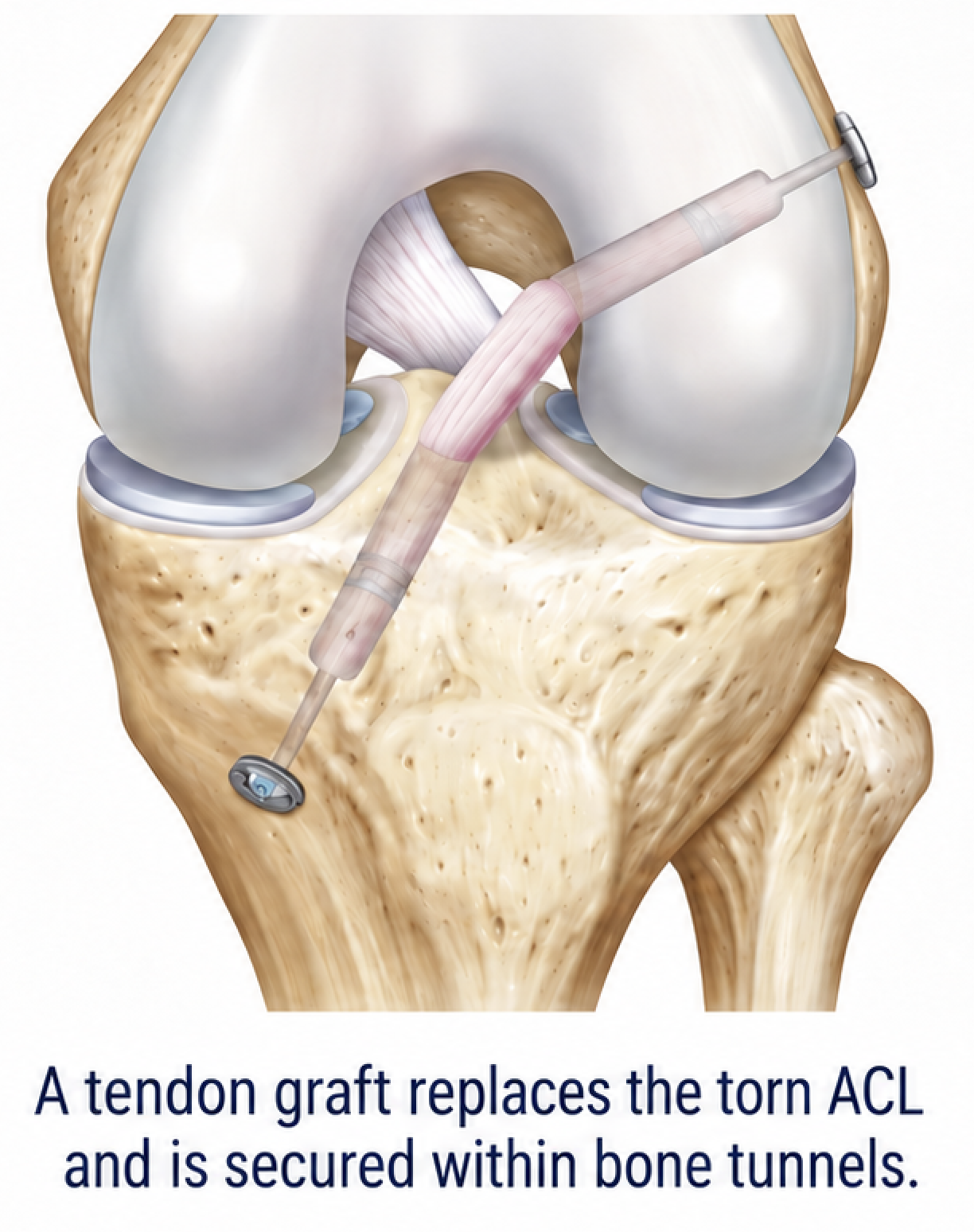
A torn ACL rarely heals back to normal, so it is reconstructed rather than repaired. A new ligament made from a tendon graft is placed in the same position as the original ACL, through small tunnels in the thigh bone and shin bone. Over the following months, the graft heals into the bone and gradually remodels into a strong new ligament.
1. ACL Tear: the injury, diagnosis and your treatment options
ACL Injury Guide
2. ACL Reconstruction (this page): the operation, recovery and return to sport.
Is ACL reconstruction right for me?
Not every ACL tear needs surgery. Reconstruction is usually recommended when:
You want to return to sports involving pivoting, cutting, jumping or contact
Your knee keeps giving way in daily life despite rehabilitation
You have a repairable meniscal tear or other ligament injuries alongside the ACL tear
Your work involves climbing, carrying or uneven ground and needs a stable knee
For a full comparison of rehabilitation and reconstruction, including the research behind each, see ACL Tear.
Choosing your graft
Three types of graft are commonly used. Each works well, and the best choice depends on your age, sport, knee anatomy and any previous surgery.
| Comparison | Hamstring tendon | Patellar tendon | Quadriceps tendon |
|---|---|---|---|
| Taken from | Tendons at the back of the thigh, via a small incision on the inner shin | The middle third of the tendon below the kneecap, with small bone blocks | The tendon above the kneecap |
| Strengths | Small incision, less pain at the front of the knee and with kneeling | Bone-to-bone healing and a long track record in pivoting athletes | A thick, reliable graft, with less kneeling pain than the patellar tendon |
| Considerations | Graft size varies, and the hamstrings are temporarily weaker | More pain at the front of the knee and with kneeling | The quadriceps are temporarily weaker |
Donor (allograft) tendons are generally reserved for revision or multi-ligament surgery.
Added stability for higher-risk knees
Some patients have a higher risk of the new graft re-tearing, particularly young athletes returning to pivoting sport, people with very loose ligaments, and knees with a large rotational "pivot shift". For these patients, Dr Arora may add a lateral extra-articular tenodesis (LET). This is a small additional procedure on the outer side of the knee that helps control rotation and protect the graft. In the large STABILITY randomised trial of young, high-risk patients, adding an LET to a hamstring ACL reconstruction reduced graft rupture from 11% to 4% at two years.
Meniscal repair at the same time
Around half of ACL injuries include a meniscal tear. These are treated during the same operation, and the meniscus is repaired rather than trimmed wherever possible, because keeping it protects the knee long term. A repair may slightly change your early rehabilitation. See Meniscal Tear.
Children and teenagers
Children and teenagers who are still growing can have ACL reconstruction using techniques that protect the growth plates near the knee. The graft and tunnel positions are chosen according to how much growth remains, which is usually judged from x-rays. Follow-up continues until growth is complete to check that both legs grow evenly. Rehabilitation and a gradual return to sport are just as important as in adults.
What is involved in ACL reconstruction?
Before surgery ("prehab")
Surgery is planned once swelling has settled and the knee bends and straightens well. Physiotherapy before surgery to restore movement and quadriceps strength leads to a smoother recovery.
Arthroscopy
Through small incisions, the knee is inspected with a camera. Any meniscal or cartilage injury is treated, and meniscal tears are repaired where possible.
Graft harvest and tunnels
The chosen graft is harvested and prepared. Tunnels are drilled in the thigh bone and shin bone at the points where the original ACL attached.
Fixation and testing
The graft is passed through the tunnels and fixed securely. An LET is added if needed. Knee stability and movement are checked before the incisions are closed.
Your recovery
Most patients go home the same day or the next day, walking with crutches. Rehabilitation with a physiotherapist starts straight away and continues for nine to twelve months.
Recovery at a glance.
-
Day 0–1
Home with crutches, starting exercises to straighten the knee and activate the quadriceps
-
1–3 weeks
Weaning off crutches as swelling settles and walking normalises
-
2–4 weeks
Return to desk-based work or school
-
around 4-6 weeks
Driving, once cleared at review (sooner for a left knee in an automatic car)
-
3-4 months
Straight-line running, if strength and control goals are met
-
6 months
Agility, jumping and sport-specific drills
-
9-12 months
Return to pivoting or contact sport, once return-to-sport testing is passed
Progress is guided by strength, control and confidence milestones rather than the calendar alone. A meniscal repair or other procedures may slow the early stages. See Post-operative Recovery & Rehab Protocols.
Returning to sport
Returning to pivoting sport too early is one of the biggest risks for re-injury. Research has shown that returning before nine months, or without meeting objective strength and function criteria, substantially increases the chance of a second ACL injury. Before you go back to sport, Dr Arora and your physiotherapist will usually check:
Quadriceps and hamstring strength close to that of the other leg
Hop and agility testing
A knee that stays settled, without swelling, during training
Psychological readiness and confidence
Continuing an injury-prevention warm-up, such as the Netball KNEE Program or FIFA 11+, after you return also helps protect both knees.
General risks overview
IMPORTANT TO KNOW
As with any surgical procedure, ACL reconstruction carries risks. Potential risks and complications include:
Infection
Blood clots (deep vein thrombosis or pulmonary embolism)
Stiffness or loss of full straightening
Graft re-tear or stretching, or an ACL injury to the other knee
Pain at the graft site, or discomfort when kneeling
Numbness beside the incision
Nerve or blood vessel injury
Arthritis developing in the long term, often related to the original injury
Risks associated with anaesthesia
This is a general overview and not a complete list. Dr Arora will discuss the risks and benefits relevant to you in detail before surgery.
ACL Reconstruction Frequently Asked Questions
The operation
-
It depends on your age, sport and knee. See "Choosing your graft" above. Dr Arora will explain his recommendation for you at consultation.
-
A lateral extra-articular tenodesis is a small additional procedure that helps control rotation of the knee and protect the graft. It is usually recommended for young athletes returning to pivoting sport and for knees with high rotational laxity.
-
Where the tear is repairable, yes. Keeping the meniscus protects the knee long term. A repair may slightly change your early rehabilitation.
-
The operation usually takes around 1 to 1.5 hours. Most patients go home the same day or the next morning.
-
A brace is not usually needed after a standard ACL reconstruction. One may be used if a meniscal repair or other ligament surgery is performed at the same time.
-
Yes. Techniques that protect the growth plates are used, and follow-up continues until growth is complete.
Recovery
-
Usually within one to three weeks, once you can walk without a limp and the knee is straightening fully.
-
Usually around four to six weeks for a right knee, once you can brake firmly and have been cleared at review. It may be sooner for a left knee in an automatic car.
-
Desk-based work and school are often possible from two to four weeks. Physical or manual work may take three months or more.
-
Straight-line running usually starts around three to four months, once strength and control goals are met.
-
Return to pivoting or contact sport is usually at nine to twelve months, and only once return-to-sport testing is passed. Non-pivoting activities such as cycling and swimming resume much earlier.
-
The graft takes many months to remodel and strengthen inside the knee, and it takes time to rebuild strength, balance and confidence. Rushing this step is one of the main causes of re-injury.
The long term
-
Yes. The risk is highest in young athletes returning to pivoting sport, which is why an LET where appropriate, a full rehabilitation program and return-to-sport testing are so important.
-
Yes. After an ACL injury, the other knee is also at increased risk, so strength and injury-prevention training should continue for both legs.
-
Reconstruction restores stability and helps protect the meniscus and cartilage from further damage. It can't undo damage from the original injury, so some people still develop arthritis later in life.
-
Most people can kneel, although it may be uncomfortable for several months, particularly after a patellar tendon graft.
-
Complete your full rehabilitation, return to sport only once you pass testing, and use an injury-prevention warm-up such as the Netball KNEE Program or FIFA 11+ at every training session.
-
A failed graft can usually be revised with a second reconstruction. Revision is planned carefully with up-to-date imaging, and sometimes in two stages if the original tunnels need to be filled first.
Trusted resources
These independent sources give more information about ACL reconstruction, rehabilitation and injury prevention.
PATIENT INFORMATION
INJURY PREVENTION
FURTHER READING: THE EVIDENCE
External links are provided for general information. Dr Arora is not responsible for the content of external websites.
General information only. Any surgical or invasive procedure carries risks. Before proceeding, you should seek a second opinion from an appropriately qualified health practitioner.

Knee Surgery in Melbourne
To discuss ACL reconstruction, call (03) 9088 8420 or contact Dr Varun Arora to schedule a consultation. A GP referral is required.