
MPFL Reconstruction
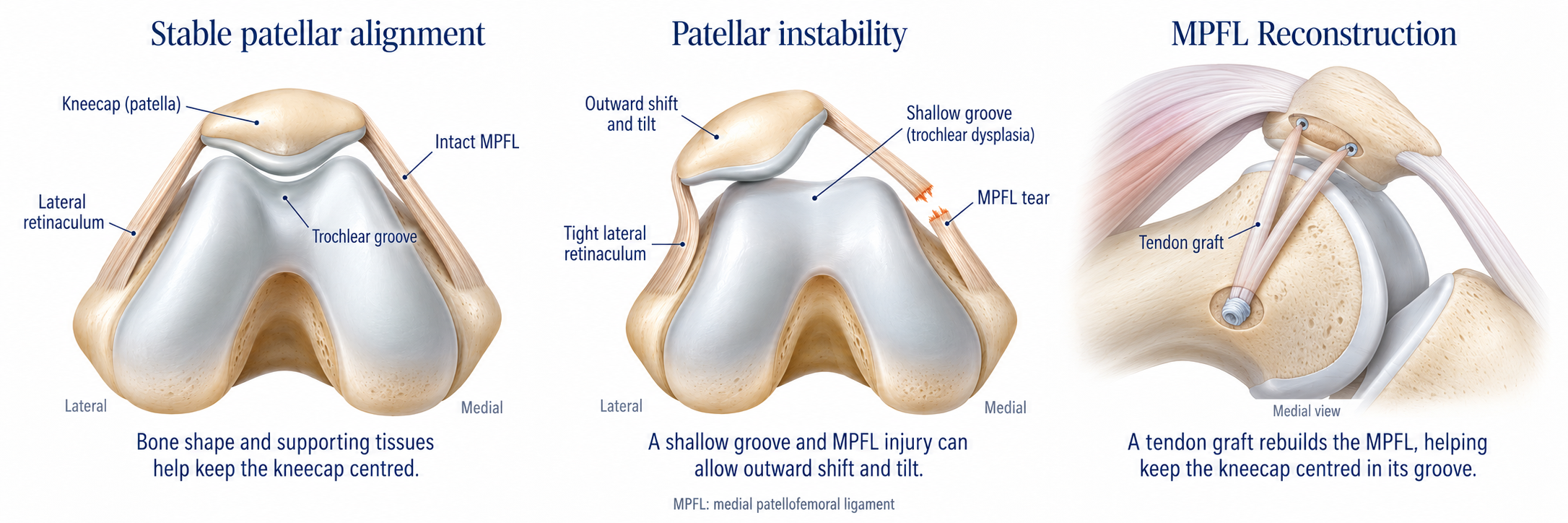
MPFL (medial patellofemoral ligament) reconstruction is an operation to treat recurrent instability or dislocation of the kneecap (patella). It is the most common operation for a kneecap that keeps dislocating.
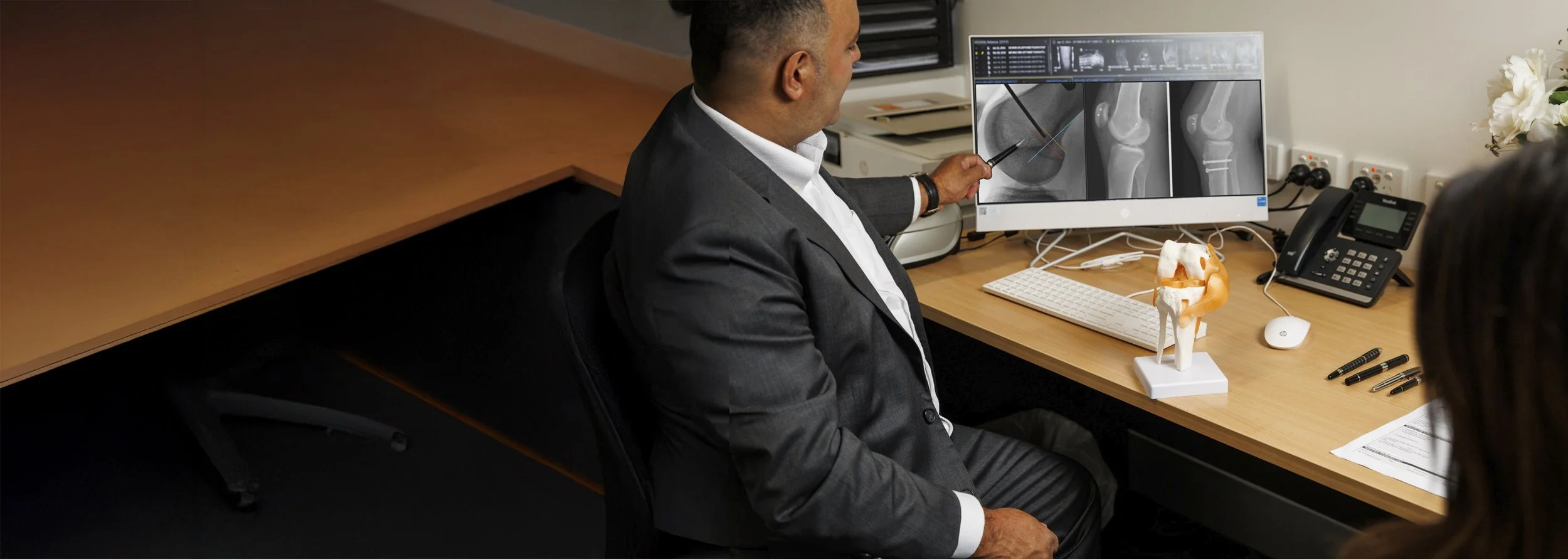
Dr Varun Arora performs MPFL reconstruction for patients across Melbourne and regional Victoria with ongoing kneecap instability, using a tendon graft to rebuild the ligament.
What is MPFL reconstruction?
The MPFL runs from the inner side of the kneecap to the thigh bone, and is the main ligament stopping the kneecap from slipping outwards. It is almost always torn or stretched when the kneecap dislocates, and often doesn't heal at the right tension. MPFL reconstruction replaces it with a tendon graft that acts as a "check rein", guiding the kneecap into its groove as the knee bends.
1. Patella Instability → causes, first dislocations and your options
Kneecap Instability Guide
2. MPFL Reconstruction (this page): rebuilding the ligament that holds the kneecap
3. Patella Realignment → correcting the bony factors behind instability
Is MPFL reconstruction right for me?
Most first-time dislocations are treated with physiotherapy. MPFL reconstruction is usually recommended when:
The kneecap has dislocated more than once
You feel the kneecap slipping, or don't trust the knee, despite a good course of physiotherapy
Instability is stopping you from returning to sport, work or daily activities
A first dislocation has caused a loose fragment needing surgery, and the ligament is stabilised at the same time
After a first dislocation in a patient with several high-risk features, where the chance of further dislocations is high
Before recommending surgery, Dr Arora assesses the anatomical factors behind your instability, such as the shape of the groove, the height of the kneecap and the TT–TG distance. These are explained on Patella Instability. When the kneecap's anatomy is close to normal, MPFL reconstruction alone usually gives a stable knee.
When MPFL reconstruction alone isn't enough
If your instability is also driven by a high-riding kneecap, a large TT–TG distance, severe groove dysplasia or marked rotation, MPFL reconstruction is combined with a bony procedure, most often a tibial tubercle osteotomy. See Patella Realignment.
Graft options
The new ligament is made from a tendon graft. Common options include:
Hamstring tendon (usually the gracilis or semitendinosus) taken from the inner side of the same knee through a small incision. This is the most widely used graft.
Quadriceps tendon, using a strip of the tendon above the kneecap. It can be left attached to the kneecap, so no bone tunnel is needed there.
Donor tendon (allograft), sometimes used in revision surgery or when your own tendons aren't suitable
Children and teenagers
Kneecap instability often starts in the teenage years. In children who are still growing, the growth plate at the lower end of the thigh bone sits very close to where the MPFL attaches. Surgery is adapted to protect it:
The attachment point on the thigh bone is positioned carefully using x-ray imaging in theatre, to avoid drilling across the growth plate
Soft-tissue fixation techniques that need no bone tunnel in the thigh bone may be used
Bony realignment procedures are generally delayed until growth is complete
Assessment includes your child's remaining growth, usually judged from x-rays.
What is involved in MPFL reconstruction?
Before surgery
Your scans are reviewed to confirm that MPFL reconstruction alone is the right operation. Physiotherapy beforehand to settle swelling and build quadriceps strength helps recovery.
Arthroscopy
The knee is usually inspected with a camera first. Any loose fragments are removed or fixed, and the cartilage behind the kneecap is checked.
Your recovery
Most patients go home the same day or the next day. Recovery involves a period of bracing and protected movement, followed by a structured physiotherapy program to restore strength, movement and stability.
Graft harvest and placement
The tendon graft is harvested and prepared. It is attached to the inner edge of the kneecap, then passed beneath the soft tissues to the thigh bone. The attachment point on the thigh bone is confirmed on x-ray, as accurate positioning is important for a good result.
Fixation and testing
The graft is fixed with the knee bent so the kneecap sits centrally in its groove, without over-tightening. The movement and tracking of the kneecap are tested through a full range of motion before the incisions are closed.
Recovery at a glance.
-
Day 0–1
Home with crutches and a hinged brace, starting quadriceps and movement exercises -
0-6 weeks
Weight-bearing as comfortable in the brace, with knee bend gradually increased
-
2–4 weeks
Weaning off crutches. Return to school or desk-based work.
-
around 4-6 weeks
Brace stopped. Driving once you can brake firmly and are cleared at review.
-
6-12 weeks
Full movement, cycling, swimming and progressive strengthening
-
around 3 months
Straight-line running, if strength and control goals are met
-
4–6 months
Return to sport, including pivoting and contact sport, once criteria are met
If a bony realignment is performed at the same time, weight-bearing is protected for longer and return to sport is usually later. See Patella Realignment and Post-operative Recovery & Rehab Protocols.
Returning to sport
Most patients return to sport after MPFL reconstruction. Return is guided by milestones, not just time. Before going back to pivoting or contact sport, you should have:
Full, comfortable knee movement without swelling
Quadriceps and hip strength close to that of the other leg
Good balance, hopping and landing control
Confidence that the kneecap feels stable
Continuing strength work and an injury-prevention warm-up after returning helps protect both knees.
General risks overview
IMPORTANT
As with any surgical procedure, MPFL reconstruction carries risks. Potential risks and complications include:
Infection
Blood clots (deep vein thrombosis or pulmonary embolism)
Stiffness or loss of knee bend
Recurrent instability or graft failure
Over-tightening, which can increase pressure behind the kneecap
Fracture of the kneecap (uncommon)
Ongoing pain around the kneecap
Numbness beside the incision
Nerve or blood vessel injury
Risks associated with anaesthesia
This is a general overview and not a complete list. Dr Arora will discuss the risks and benefits relevant to you in detail before surgery.
MPFL Reconstruction Frequently Asked Questions
Is it right for me?
-
It is generally considered for patients with recurrent kneecap instability or dislocation, particularly when physiotherapy has not resolved the problem.
-
For most people, yes. If you have a high-riding kneecap, a large TT–TG distance or severe groove dysplasia, an additional bony procedure may be recommended. See Patella Realignment.
The operation
-
Most commonly a hamstring tendon from the same knee, although a quadriceps tendon or donor graft may be used. Dr Arora will explain his recommendation at consultation.
-
Partly. The knee is usually inspected arthroscopically, and the graft is placed through small incisions near the kneecap and on the inner side of the thigh bone.
-
The operation usually takes around 1 to 1.5 hours. Most patients go home the same day or the next morning.
-
A hinged brace is usually worn for the first four to six weeks. It protects the knee while the graft heals and movement returns.
Recovery and sport
-
Most people are walking without crutches within a few weeks and back to normal daily activities within two to three months. Return to sport is usually from four to six months.
-
School and desk-based work are often possible from two to four weeks. Physical work may take three months or more.
-
Usually around four to six weeks, once you can brake firmly and have been cleared at review. It may be sooner for a left knee in an automatic car.
-
Usually from four to six months for pivoting and contact sport, once strength, control and confidence goals are met. It may take longer if other procedures were combined.
-
Most people can kneel, although it may be uncomfortable for several months.
The long term
-
The risk is low after well-planned surgery, and MPFL reconstruction substantially reduces the chance of further dislocation. However, no surgery can guarantee it will never happen again.
-
The anatomical factors behind instability are often present in both knees. If the other knee also dislocates, it can be assessed and treated in the same way, usually at a separate time.
-
Keep up quadriceps, hip and core strengthening, and use an injury-prevention warm-up for sport.
-
A further operation is possible. It is planned after a careful review of why the instability returned, which often means addressing a bony factor as well. See Patella Realignment.
Trusted resources
These independent sources give more information about kneecap instability and MPFL reconstruction.
PATIENT INFORMATION
PROCEDURE INFORMATION
External links are provided for general information. Dr Arora is not responsible for the content of external websites.
General information only. Any surgical or invasive procedure carries risks. Before proceeding, you should seek a second opinion from an appropriately qualified health practitioner.

Knee Surgery in Melbourne
If your kneecap keeps dislocating or feels unstable, call (03) 9088 8420 or contact Dr Varun Arora to schedule a consultation. A GP referral is required.