

Anterior Approach Hip Replacement
Overview
The direct anterior approach is a way of performing a total hip replacement through the front of the hip. Instead of detaching muscles at the back or side of the hip, the joint is reached through a natural gap between muscles.
Dr Varun Arora uses this approach for most of his hip replacement patients across Melbourne and regional Victoria, usually through a bikini incision. For an overview of the operation itself, see Hip Replacement.
Dr Arora's experience
Dr Arora has extensive training in the direct anterior approach, including a dedicated fellowship in anterior hip replacement with the Melbourne Orthopaedic Group. He has also trained with leading anterior-approach hip replacement surgeons in France, Switzerland and the United Kingdom. He uses this experience to choose the right approach and incision for each patient.

What is the anterior approach?
At the front of the hip, the joint sits relatively close to the skin. Here the surgeon can pass between muscles rather than through them, leaving the tendons at the back of the hip undisturbed.
You lie on your back during surgery. This allows leg lengths to be compared directly and intraoperative x-ray (fluoroscopy) to be used to check the position of the components before the operation is finished.
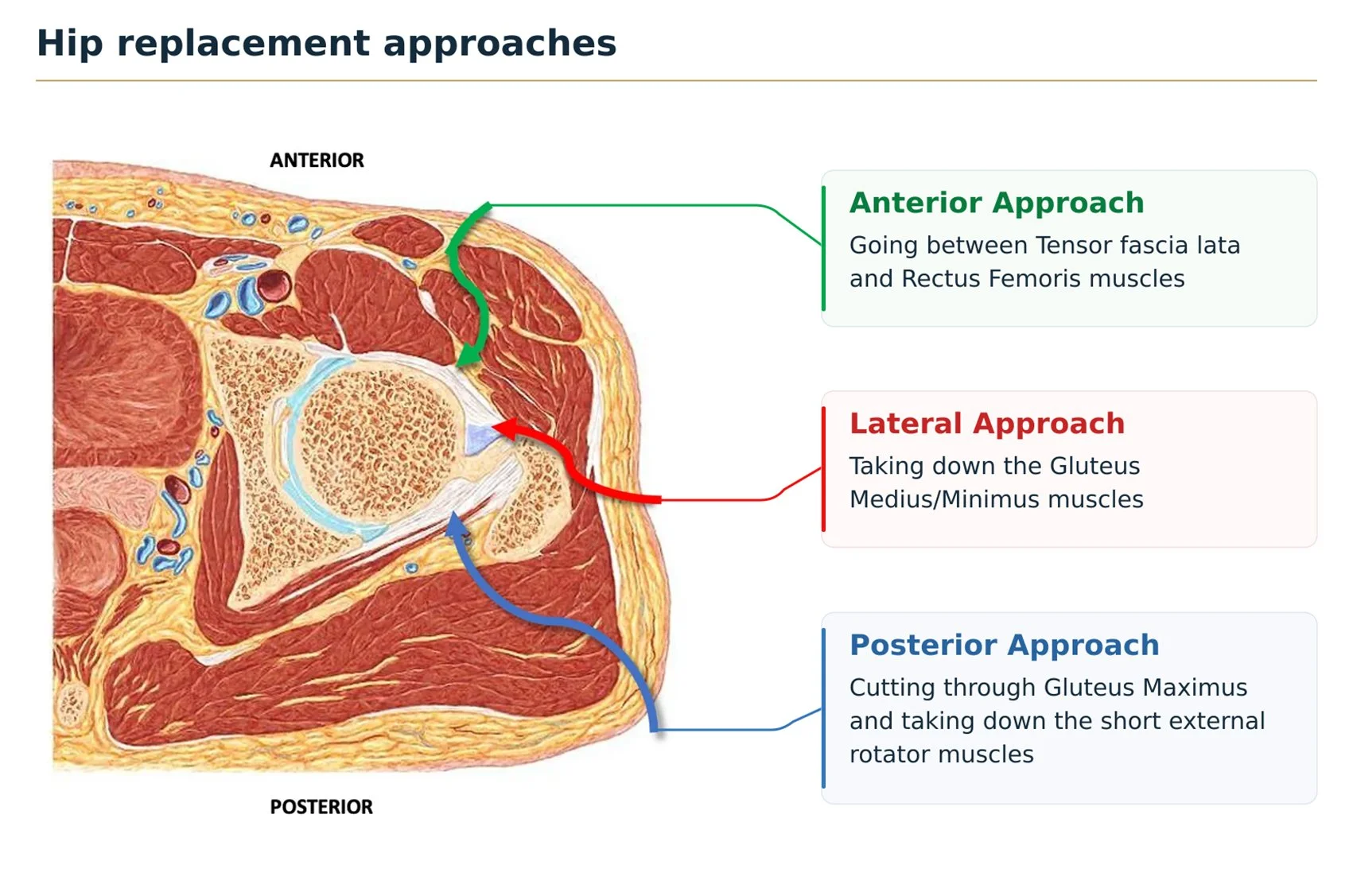
Bikini or longitudinal incision?
The anterior approach can be performed through two types of skin incision. The deeper surgery is the same with both. What differs is the direction of the cut in the skin.
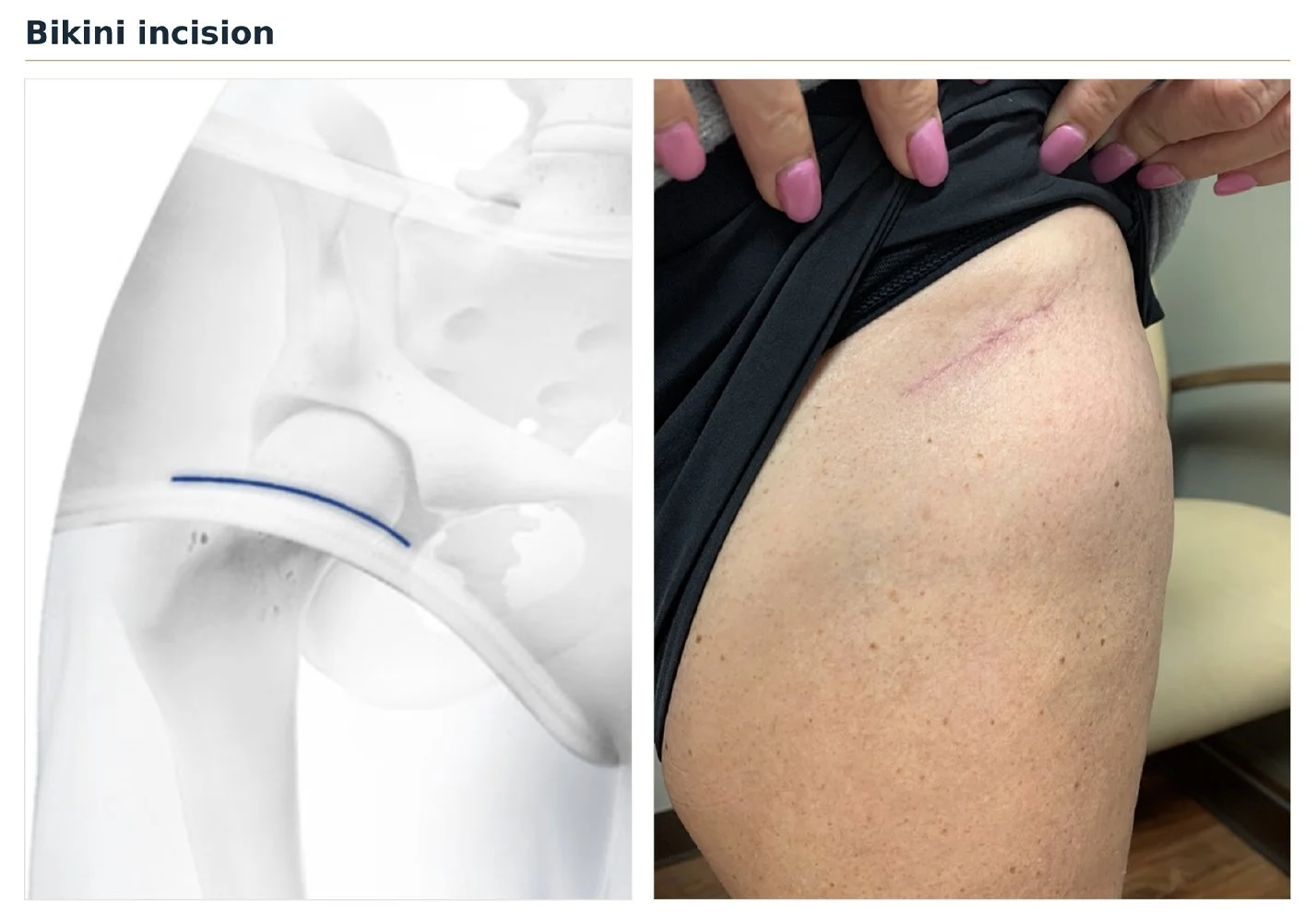
Bikini incision - Dr Arora's preference
An angled incision of about 8–10 cm placed along the natural skin crease at the front of the hip, usually hidden beneath underwear or swimwear.
Potential benefits
Follows the skin's natural creases and tension lines, so the scar tends to be finer and less noticeable
Studies report higher patient satisfaction with scar appearance
Hip function, recovery and implant position are similar to the longitudinal incision.
Things to consider
Thigh numbness can be more common in the first few months than with a longitudinal incision. Studies show the difference largely evens out by about six months.
It can't be extended as easily if more exposure is needed during surgery
It isn't suitable for every body shape or every hip.
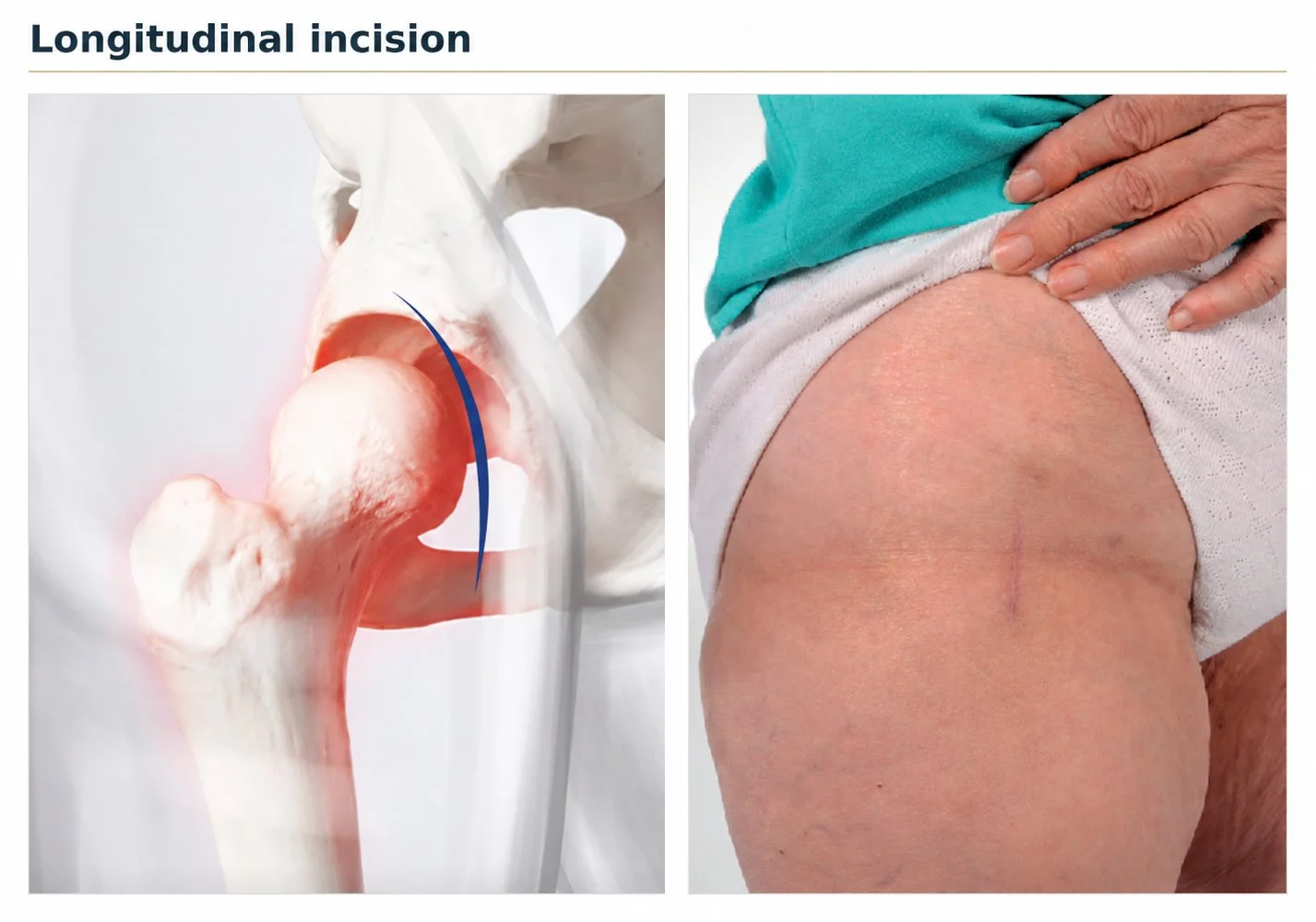
Longitudinal incision
A straight incision of about 8–12 cm running down the front of the upper thigh, just below and to the side of the hip crease.
Potential benefits
Can be lengthened during surgery if more access is needed, which suits complex cases
Gives reliable access to the thigh bone in more muscular or larger patients
The traditional anterior incision, with long-established results.
Things to consider
It crosses the skin's natural tension lines, so the scar can be wider and more visible
Thigh numbness can still occur, as with any anterior incision.
When is a longitudinal incision recommended?
Dr Arora may recommend a longitudinal incision if you have:
A large abdominal skin fold overlying the groin crease, where a crease wound may be slower to heal
Complex anatomy, such as hip dysplasia, deformity or a stiff hip, needing wider access
Previous surgery, scars or metalwork around the hip
A very muscular build, or bone quality that calls for more access to the thigh bone.
The choice is made with you at your consultation, and both incisions give the same hip replacement underneath.
Potential advantages of the anterior approach
Muscles and tendons are spared, because the approach works between muscles
An earlier return to walking and daily activities in the first few weeks for some patients
A low risk of dislocation, so most patients have few or no movement precautions
Leg length and implant position can be checked with x-ray during surgery
These differences are mostly seen in the early weeks. By around three months, patients who have had different approaches generally function at a similar level, and long-term results are similar.
Is the anterior approach right for me?
Many people with hip arthritis are suitable. Dr Arora will consider your body shape, bone quality and hip shape, and any previous surgery or metalwork. For some patients, a posterior or lateral approach is the safer choice and gives an equally good result.
What is involved?
Planning
X-rays and, where helpful, a CT scan for 3D planning are used to set implant size, position and leg length in advance.
Preparation of the bone and implantation
Through the anterior interval, the worn ball is removed, the socket is prepared and the new components are fitted. Robotic assistance can be combined with the anterior approach. See Robotic Hip & Knee Replacement.
Alignment and testing
Component position and leg length are confirmed with intraoperative x-ray, and stability is tested before closing.
Your recovery
Most patients walk on the day of surgery or the next day and go home after 1–3 nights. Driving is usually possible from around 4–6 weeks, and low-impact exercise from 6–12 weeks.
Risks specific to the anterior approach
IMPORTANT TO KNOW
In addition to the general risks of hip replacement:
Thigh numbness. A skin nerve near the incision (the lateral femoral cutaneous nerve) can be affected with either incision. A patch of numbness on the outer thigh is common. It usually improves over months but can be permanent, and it does not affect strength or walking.
Femoral fracture or early loosening. Preparing the thigh bone from the front is technically demanding. Careful implant selection and technique reduce this risk.
Wound healing. Wounds near the groin crease can be slower to heal in some body shapes, which is one reason the incision is chosen individually.
Frequently Asked Questions
-
With a bikini incision the scar usually sits in the skin crease and is hidden by underwear or swimwear. Every person heals differently, and scars continue to fade for 12 to 18 months.
-
You're welcome to ask. Dr Arora uses it whenever it is suitable, which applies to most of his patients. If a longitudinal incision is safer for you, he will explain why.
-
It is muscle-sparing rather than keyhole surgery. The incision is modest, but the hip replacement itself is the same complete operation.
-
There is no good evidence that the approach or incision changes how long a hip replacement lasts. Longevity depends mainly on implant choice, positioning and fixation.
-
Most patients have few or no formal movement restrictions. You'll receive specific advice from Dr Arora and your physiotherapist.
-
Yes. When both hips need replacing, the anterior approach can be used on each side, either together or a few months apart.
Further reading
External links are provided for general information.
General information only. Any surgical or invasive procedure carries risks. Before proceeding, you should seek a second opinion from an appropriately qualified health practitioner.

BOOK A CONSULTATION
Pelvis & Hip Surgery in Melbourne
If you would like to discuss your symptoms or treatment options, call (03) 9088 8420 or contact Dr Varun Arora.